Attic sanitation and insulation restoration resolves biological contamination caused by roof rats, gray squirrels, raccoons, and roosting bats. In Hillsborough County, elevated summer attic temperatures exceeding 130…
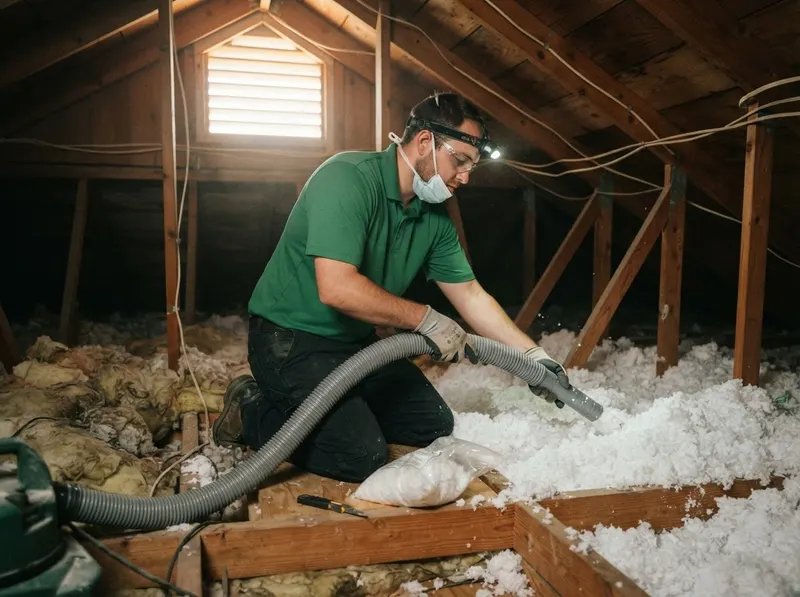
Attic sanitation and insulation restoration resolves biological contamination caused by roof rats, gray squirrels, raccoons, and roosting bats. In Hillsborough County, elevated summer attic temperatures exceeding 130 degrees Fahrenheit accelerate the breakdown of biological waste, vaporizing pheromones and dry particulate throughout connected ceiling junctions, recessed lighting cans, and attic hatches. Left unaddressed, these biological traces draw new rodent populations back into the structural envelope along plumbing chases and roof valleys. A complete extraction strips out these lingering attractants rather than covering them up.
Local architectural styles directly dictate the required restoration methods. In older single-story properties across Brandon Hills, Limona, and Heather Lakes, blown-in loose-fill cellulose or degraded fiberglass often sits compressed well below modern efficiency standards, requiring full bulk-vac extraction via exterior 6-inch hoses routed directly to an outside collection unit. In two-story construction found throughout Bloomingdale, Providence Lakes, and Brentwood Hills, complex multi-pitch rooflines and vaulted drywall ceilings demand focused bio-enzymatic spray applications directly to OSB roof decking, truss plates, and top wall plates. For homes near damp, wooded corridors like the Alafia River watershed, Cross Creek Park, and Sterling Ranch, ambient relative humidity can foster secondary fungal growth on soiled paper vapor barriers. Addressing this requires broad-spectrum, non-volatile disinfectants that leave zero toxic chemical residues behind for indoor domestic animals.
Choosing between partial spot repair and full attic remediation depends on the distribution of fecal matter and the age of the underlying thermal layer. If roof rat activity was isolated to a small perimeter overhang in Valrico Forest, clearing 100 square feet around the primary entry point alongside entry-hole exclusion preserves intact insulation. However, when droppings cross central catwalks or air-handling trunk lines, localized patches leave aerosolized particulate within the thermal envelope; a comprehensive clear-out is the only method that fully re-establishes thermal efficiency to standard R-38 depth (approximately 13 to 14 inches of blown fiberglass) while neutralizing animal scents. Homeowners can reach technicians at (656) 254-1361 for an evaluation.
Every job gets a firm, written price after a free on-site visit.
Tell us about your attic sanitation and insulation restoration job in Brandon and we'll send a clear, written quote, usually the same day.
 Cypress Finch Pest Control